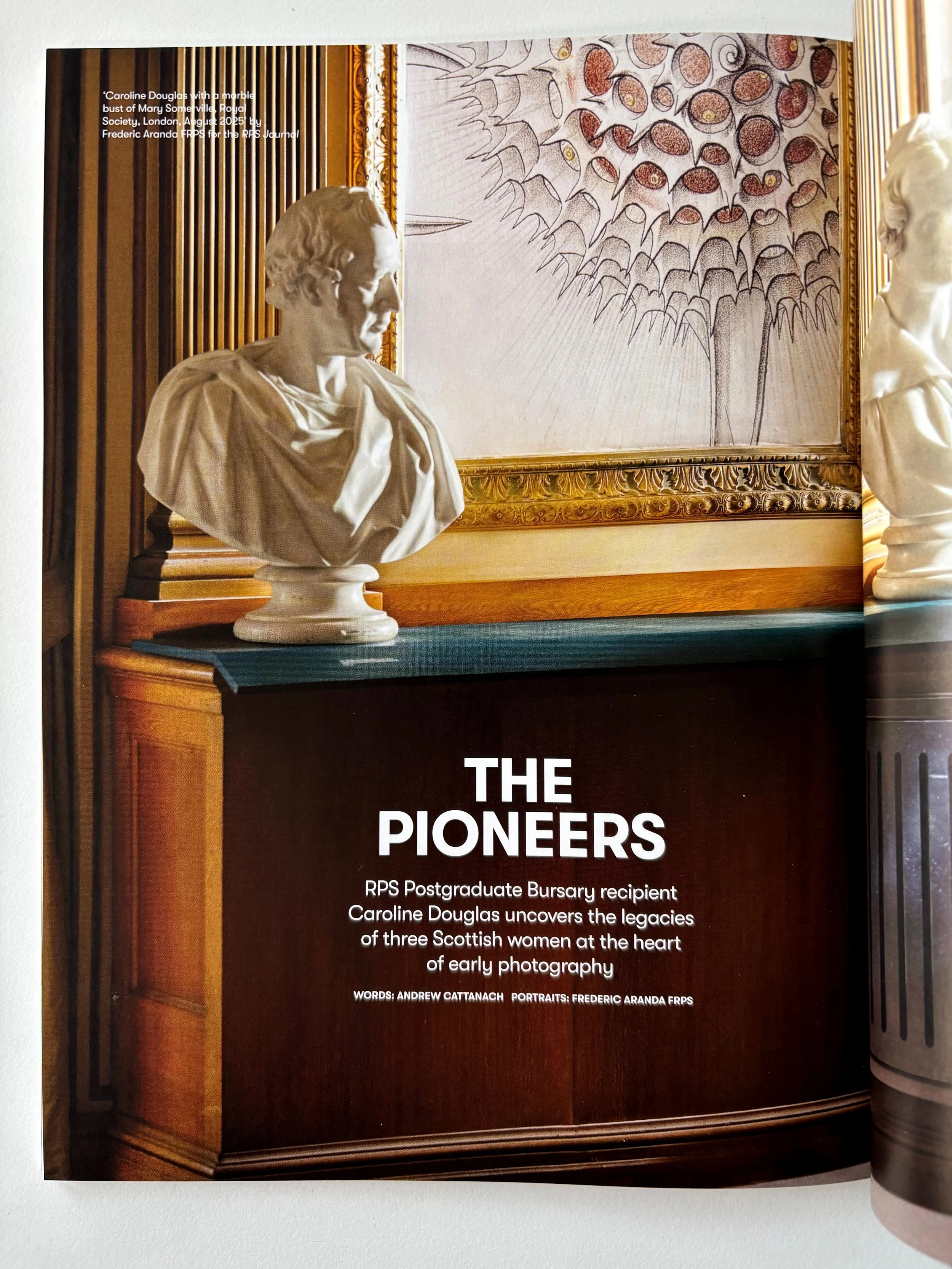
“I developed a real certainty – long before it became a formally researched thesis – that women were present at the invention of photography”
Caroline Douglas knew women had played a vital role in the history of photography long before she set out to prove it in her PhD. The conviction had built gradually – through decades of photographic practice and years of teaching at university. Somehow, she explains, the knowledge felt embedded in the work itself.
“I developed a real certainty – long before it became a formally researched thesis – that women were present at the invention of photography,” she says. “I came to this through the experience of being an artist, working with photography and being in touch with its materiality. It felt like an embodied form of knowledge. I sensed women’s contributions were there – it was just a matter of finding them.”
That seed of an idea would eventually propel Douglas to pursue a PhD at the Royal College of Art, London, partly funded by the RPS Postgraduate Bursary, awarded to her in September 2025, to support research for her final viva exhibition.
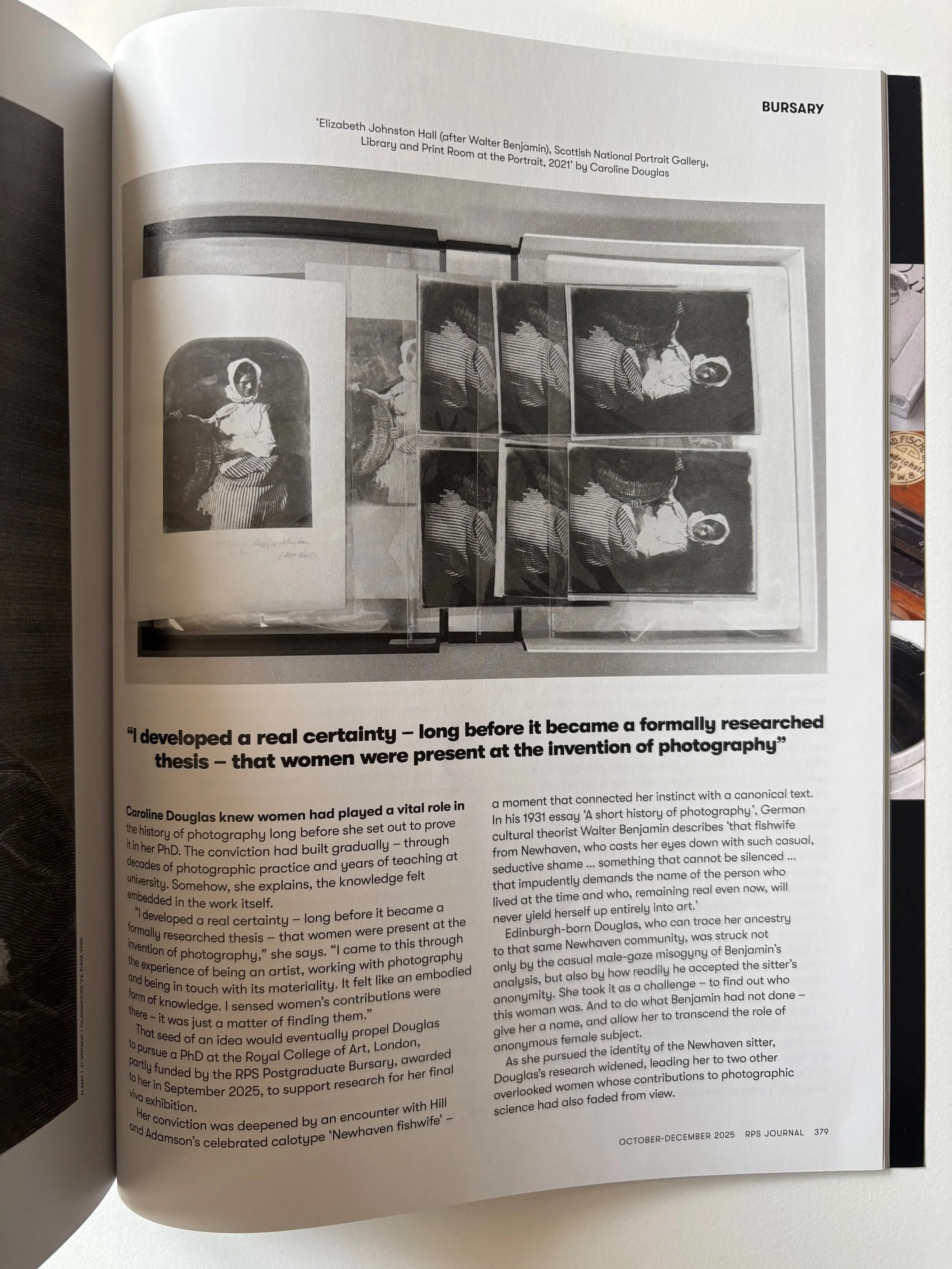
Her conviction was deepened by an encounter with Hill and Adamson’s celebrated calotype ‘Newhaven fishwife’ – a moment that connected her instinct with a canonical text. In his 1931 essay ‘A short history of photography’, German cultural theorist Walter Benjamin describes ‘that fishwife from Newhaven, who casts her eyes down with such casual, seductive shame … something that cannot be silenced … that impudently demands the name of the person who lived at the time and who, remaining real even now, will never yield herself up entirely into art.’
Edinburgh-born Douglas, who can trace her ancestry to that same Newhaven community, was struck not only by the casual male-gaze misogyny of Benjamin’s analysis, but also by how readily he accepted the sitter’s anonymity. She took it as a challenge – to find out who this woman was. And to do what Benjamin had not done – give her a name, and allow her to transcend the role of anonymous female subject.
As she pursued the identity of the Newhaven sitter, Douglas’s research widened, leading her to two other overlooked women whose contributions to photographic science had also faded from view.
“I started remaking some of Somerville’s experiments with light, using whatever was to hand – kitchen appliances, soup bowls for emulsions”
Alongside her investigation into the Newhaven image, Douglas was uncovering the stories of two pioneering Scottish women whose scientific work played a crucial role in the development of photographic technology – Elizabeth Fulhame (c1750-after 1794) and Mary Somerville (1780-1872). Though both have been acknowledged in the wider history of science, their contributions to early photographic processes are often overshadowed by their better-known male counterparts such as William Henry Fox Talbot and John Herschel.
Fulhame was a chemist who discovered photoreduction, observing how light could cause metallic particles to form on fabrics and other surfaces. This principle would later become essential to photographic processes such as the daguerreotype and calotype, in which silver salts on a surface are transformed by light into visible images. Mary Somerville was a polymath and a central figure in the mid-19th-century scientific community, maintaining a lifelong correspondence with Herschel. Her experiments on light, first published in 1835, predated the official announcement of photography by four years and were disseminated by the French polymath François Arago, who famously made that announcement.
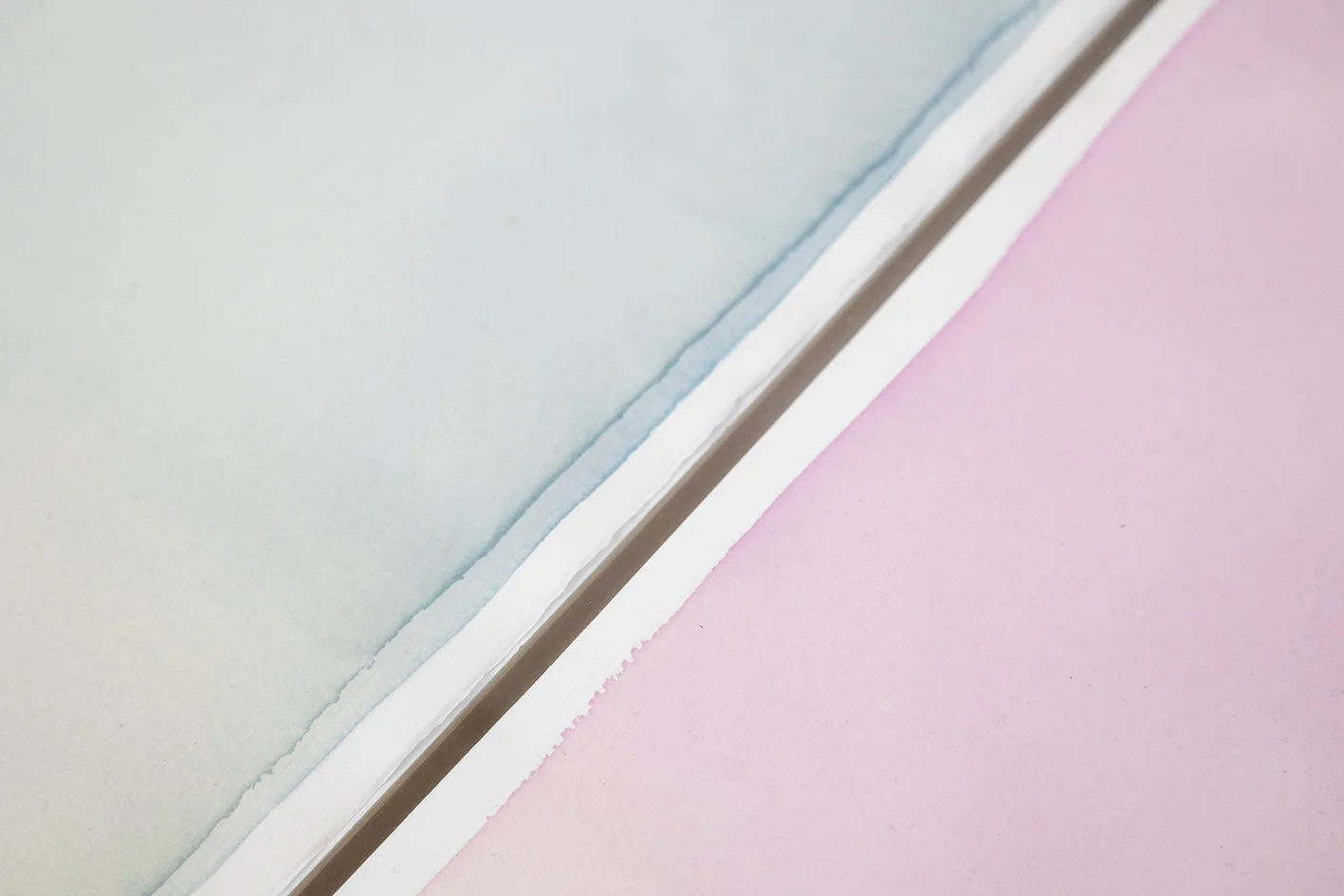
During the Covid-19 lockdown, while confined to her home, Douglas turned her domestic space into a studio and began remaking Somerville’s Experiments on light: on the action of the rays of the spectrum on vegetable juices from 1845.
“During lockdown, my home became my studio,” explains Douglas. “I started remaking some of Somerville’s experiments with light, using whatever was to hand – kitchen appliances, soup bowls for emulsions. I used my toddler’s cotton vest as a strainer, and socks too. It was about ecology but also economy – I couldn’t access what I needed so I repurposed clothing and household materials.”
She strained light-sensitive vegetable emulsions through fabric and, like her Victorian predecessors, relied on sunlight to expose the prints. “I was working at the mercy of the British weather,” she says, “although Somerville had the advantage of doing all this in Rome.”
Exposure times ranged from hours to, in some cases, weeks. The resulting images resembled test strips, with subtle gradations of tone. “In making them I was speculating that Somerville’s own test strips must exist somewhere,” Douglas adds. “I hadn’t yet seen her notebook in person, but I’d requested it during lockdown.”
A digital copy of the notebook soon arrived. Douglas was disappointed, and a little surprised, not to find the test strips she had imagined. It wasn’t until a later visit to the Bodleian Library in Oxford that she finally saw them – original test strips, tucked deep into the spine of the book. She closed it quickly, realising these fragile artefacts were still undergoing their light-sensitive process – still vulnerable to fading with each moment of exposure.
While Somerville’s experiments unfolded in the scientific salons of Rome, Douglas’s research also led her back to her own roots and to a very different kind of historical subject – the long-overlooked Newhaven Fishwife.
Discovering more about the sitter, Elizabeth Johnston Hall, proved far easier than Douglas had anticipated. Hill and Adamson, though celebrated for their artistry, were also meticulous documenters of the world around them. Unlike many of their contemporaries they often recorded the names of their working-class sitters – an uncommon practice at the time.
At the National Records of Scotland, Douglas, with the help of historian Roddy Simpson, consulted the 1841 census for Newhaven. There, they found Elizabeth Johnston Hall, an important figure in her community. Her home had served as a meeting place for fellow fisherfolk, though she later died in relative poverty. “It’s amazing what can be gleaned from bringing together historical and photographic records,” Douglas says.
Douglas went on to recreate the image herself, using the same calotype methods as Hill and Adamson, to better understand how long Hall would have had to sit for – revealing the hidden labour involved in being a photographic subject at a time when such an experience was unprecedented.
It’s unlikely Hall had posed for a photographer before, or ever would again. Yet Douglas was intrigued to discover a series of ‘outtakes’ from the session, including one in which Hall gazes directly at the viewer, wearing an enigmatic smile – as if amused by the absurdity of it all. Little could she have known that it was her unsmiling likeness that would be chosen, studied, discussed and replicated for nearly two centuries.
The RPS Postgraduate Bursary enabled Douglas to then travel to the Herschel family home near Norfolk, where she restaged Somerville’s 1845 experiment using replicas of the crystals from John Herschel’s collection that Somerville had used in her original work.
“I took some Whatman paper from the 1840s – supplied by contemporary calotypist Rob Douglas – coated it with silver chloride in the morning and travelled with it in a black bag to the Herschel family home,” Douglas explains. Once there, she arranged the replica crystals on the paper and exposed it to sunlight, allowing the objects to leave behind ghostly, luminescent impressions.
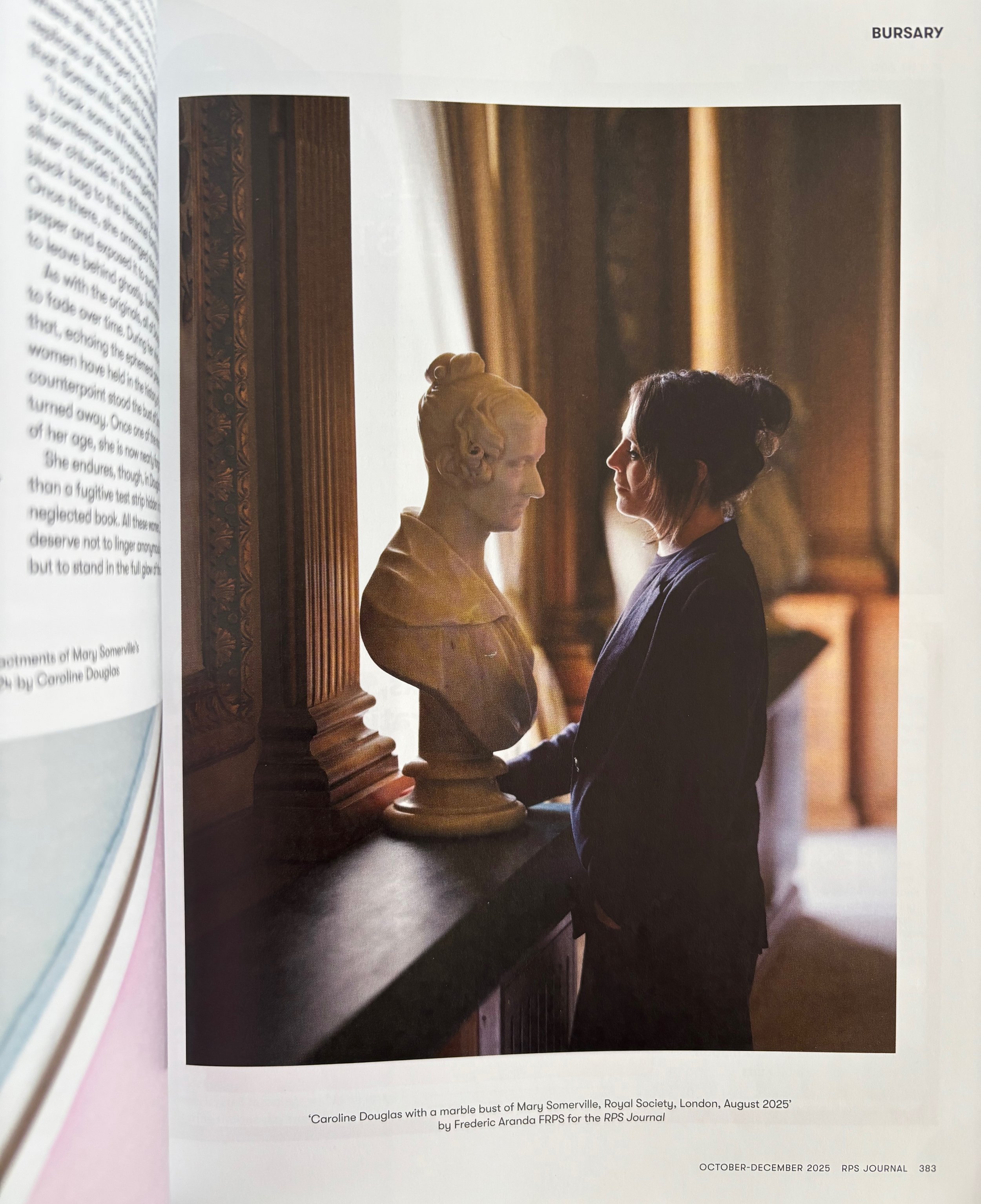
As with the originals, all of Douglas’s works are destined to fade over time. During her viva exhibition, they did just that, echoing the ephemeral presence that these three women have held in the history of photography. As a counterpoint stood the bust of Somerville, deliberately turned away. Once one of the most renowned scientists of her age, she is now nearly forgotten.
She endures, though, in Douglas’s research – more than a fugitive test strip hidden in the spine of a neglected book. All these women, Douglas included, deserve not to linger anonymously in the shadows, but to stand in the full glow of the sun.